Built for Australian Retailers
Sales, stock, invoicing. All from your phone.
Close the sale, decrement the stock, and have BAS done before the markets pack up.
Ring up on the counter tablet, close the sale at the Rose Street stall, raise the PO to your wholesaler. Stock, suppliers, GST and BAS all on the same record, no CSV export to the accountant. All-in-one for $0 to $69/mo, replaces Square POS + Xero + a stock spreadsheet.
Free plan. No card required. · GST & ABN built-in · POS, stock & CRM in one · Sign up in 60 seconds
Cut $97+/mo from your software stack by replacing Lightspeed Retail + Xero + Mailchimp + a stock spreadsheet with OneBookPlus.
See your savingsBrowse by Specialty
Specific guides for the retail business you run
Free Tools & Resources
Reference material for owners and stallholders
Start a Retail Business
8-step founder guide, ABN, GST, lease, POS, supplier terms, online channel, opening week.
ComplianceConsumer Guarantees (ACL)
Section 54 acceptable quality, section 55 fitness for purpose, refund vs replace decision tree, signage requirements.
ReferenceMarket Stall Permits by State
Food-stall permits, casual trader licences, council fees, public-liability requirements for market vendors.
Operator GuidePOS Buyer's Guide
Square vs Lightspeed vs Vend vs Shopify POS vs Tyro, features, hardware costs, transaction fees, AU support.
InteractiveMarkup & Break-Even Calculator
Interactive, cost, markup % vs margin %, retail price, GST, break-even unit volume and dollars.
Key takeaways
5- Australian retail turns over roughly $430 billion a year (ABS Retail Trade), with discretionary categories (clothing, homewares, hospitality goods) running on tight 30-40% gross margins and food/grocery on 15-25%. Most independent shops fail or thrive on stock turn, not headline sales.
- The Australian Consumer Law (ACL) makes consumer guarantees automatic on every sale: section 54 (acceptable quality), section 55 (fit for purpose), section 56 (matches description). 'No refunds' signs are unlawful when a major fault exists, refund, replacement or repair is the customer's choice.
Show 3 moreShow less
- GST is 10% on most retail sales, charged at the till and remitted quarterly via BAS. Sole-trader market stalls under $75k turnover don't have to register for GST, but most retail businesses cross the threshold quickly once they open a permanent shop.
- Market-stall and pop-up trading is governed by the local council and (for food) state health authority. Casual-trader permits typically cost $20 to $80 per market day, with public liability insurance ($10M to $20M) almost universally required by the market operator.
- POS software for AU retailers: Square is free to use with a per-tap card fee, or $40/mo for Square Plus; Lightspeed Retail, Shopify POS Pro and Tyro Direct each charge a subscription plus a transaction fee, and we do not republish their figures here. Vendor prices verified 2 August 2026. OneBookPlus bundles POS, inventory, CRM, GST and BAS in one product from $0/month.
Everything You Need
Built for How Retailers Actually Work
Forget bolting a POS to an accounting package to a spreadsheet. OneBookPlus is the retail app designed for shop owners, boutique operators and weekend stallholders: POS, stock, supplier bills and GST in one place, all mobile-first.
POS-Integrated Sales
Ring up a sale on the counter tablet, or from the phone in your apron pocket at a market stall or pop-up. Take the card on the EFTPOS terminal you already have and record the tender against the sale. Every sale lands in the same dashboard with takings, tax and the customer attached.
Inventory & Stocktake
Track SKUs, variants and stock on hand. Low-stock alerts pop up on the dashboard before you run out of the best-seller, and the end-of-month stocktake is two taps instead of a Sunday afternoon.
Customer CRM
Every sale, refund, layby and email lives on one customer record. Run a loyalty list, message your top 50 about a new drop, and remember the regular who buys the same candle every six weeks.
Supplier Billing & Purchase Orders
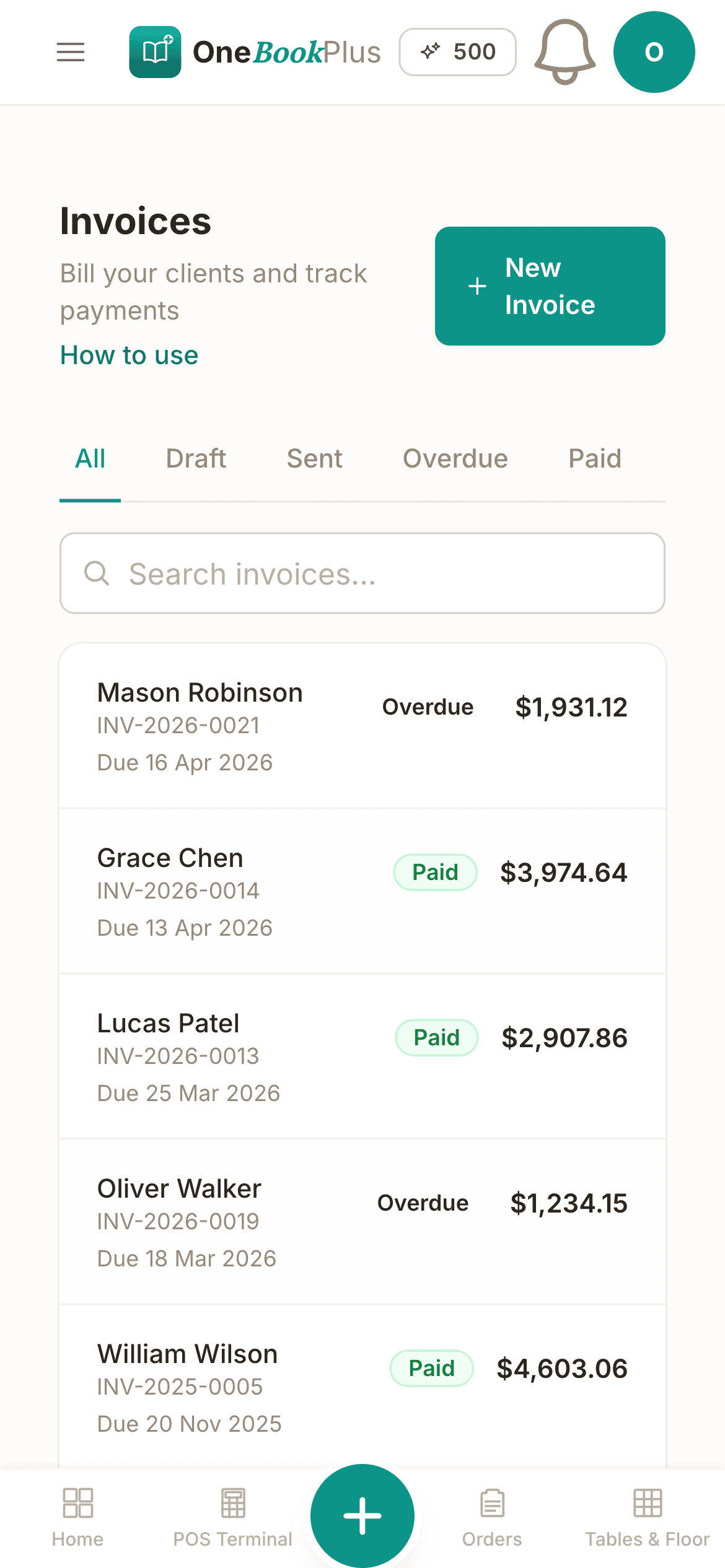
Raise a PO, mark it received, and the supplier bill flows into expenses with GST already split. Pay on terms, record the payment against the bill, and see margin per supplier, not just per product.
GST & BAS-Ready Reporting
10% GST sits on every sale and supplier bill automatically. The BAS quarterly summary exports as a single PDF, GST collected, GST paid, the net amount due, ready for the accountant or the portal.
Mobile Check-Out
At a market stall, on a pop-up trestle, or roaming the shop floor, ring the sale up on the phone, take the card on the terminal you already carry, or split with cash. The receipt arrives by SMS, no paper roll needed.
Peak-hour & weekday reports
Stop guessing when to staff up. See sales-by-hour, sales-by-weekday and the busiest category, pulled live from every closed POS sale.
Low-stock & dead-stock alerts
Get alerted before you sell out, and see which variants haven't moved in 30 days so you can mark them down, bundle them, or send them back.
Reviews on autopilot
Connect Google Business Profile and request a Google review automatically after each paid sale, the send delay is yours to set (24 hours by default).
Free plan available · No credit card · Cancel anytime
Free booking page included
Your retail business gets a booking page. Free.
Stop paying a website subscription you do not need, and skip the up-front designer quote. Every OneBookPlus retailer gets a branded booking page on the free plan. Want it on your own domain like a proper business website? The Website Builder app is $29/mo and we host it for you.
your-business.onebookplus.com.auoronebookplus.com.au/book/your-businessyourbusiness.com.au: your own branded domain, hosted by us24/7 emergency callout booking
A customer reserves the last of a sold-out homewares run or books a click-and-collect at 10pm while the shop is shut. The order lands in your dashboard with the SKU and pickup time, ready to pull from the shelf at open.
Branded with your colours, logo & licence
Brand color picker in settings. Logo upload. Trade licence number shown on every page so customers know you're legit.
Show service prices upfront
Soy candle $34. Linen throw $129. Customers see prices before booking, kills the price-shopping phone calls.
Mobile-first: looks great on phones
Your booking page is built mobile-first, so a customer searching on a phone can book without pinching to zoom.
Bring your own domain: we host the site
Already own yourbusiness.com.au? Add the Website Builder app ($29/mo) and point your domain at the site we host for you, through a guided DNS and SSL wizard. We don't sell domains, keep yours wherever you registered it.
Local SEO baked in
Schema.org markup for retail services + suburbs you cover. Google finds you for 'homewares store in [suburb]' searches.
Retailers website cost, typical
What retailers pay for a website
- From $24/mo
Website builder
Squarespace's cheapest plan billed monthly, verified 2 August 2026. Wix publishes no fixed Australian rate.
- $15 to $40/mo
Web hosting + SSL
Bundled in builders; separate if custom site
- $1,500 to $3,000
Designer (one-off)
Only if you want a custom-built site
- From US$10/mo
Bookings on Calendly
Per seat, billed in US dollars, verified 2 August 2026. Separate from your website.
Typical recurring total
~$39 to $64/mo
+ US$10/mo per seat if you add Calendly for bookings, billed in US dollars, and $1,500 to $3,000 up-front if you hire a designer
With OneBookPlus
Included on every plan
- Branded booking page, free plan
- Hosting + SSL, free plan
- 24/7 customer self-booking, free plan
- Connect your own domain with the Website Builder app, +$29/mo (BYO)
Your total
$0 to $29/mo
See it in action
The screens between the counter and the books.
Not mockups, the real product screens for a trading Saturday on the shop floor and at the market stall.
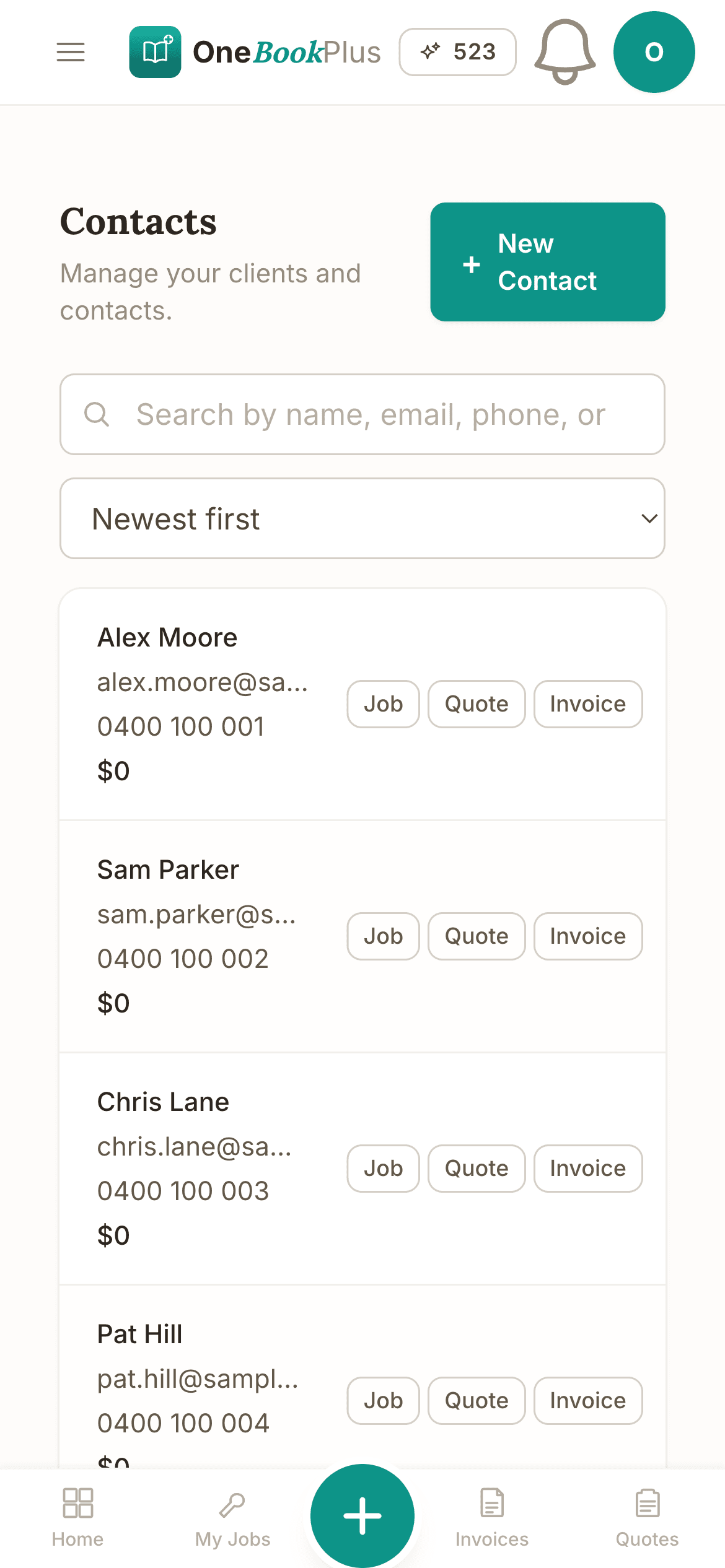
Ring up a sale at the counter: or on your phone
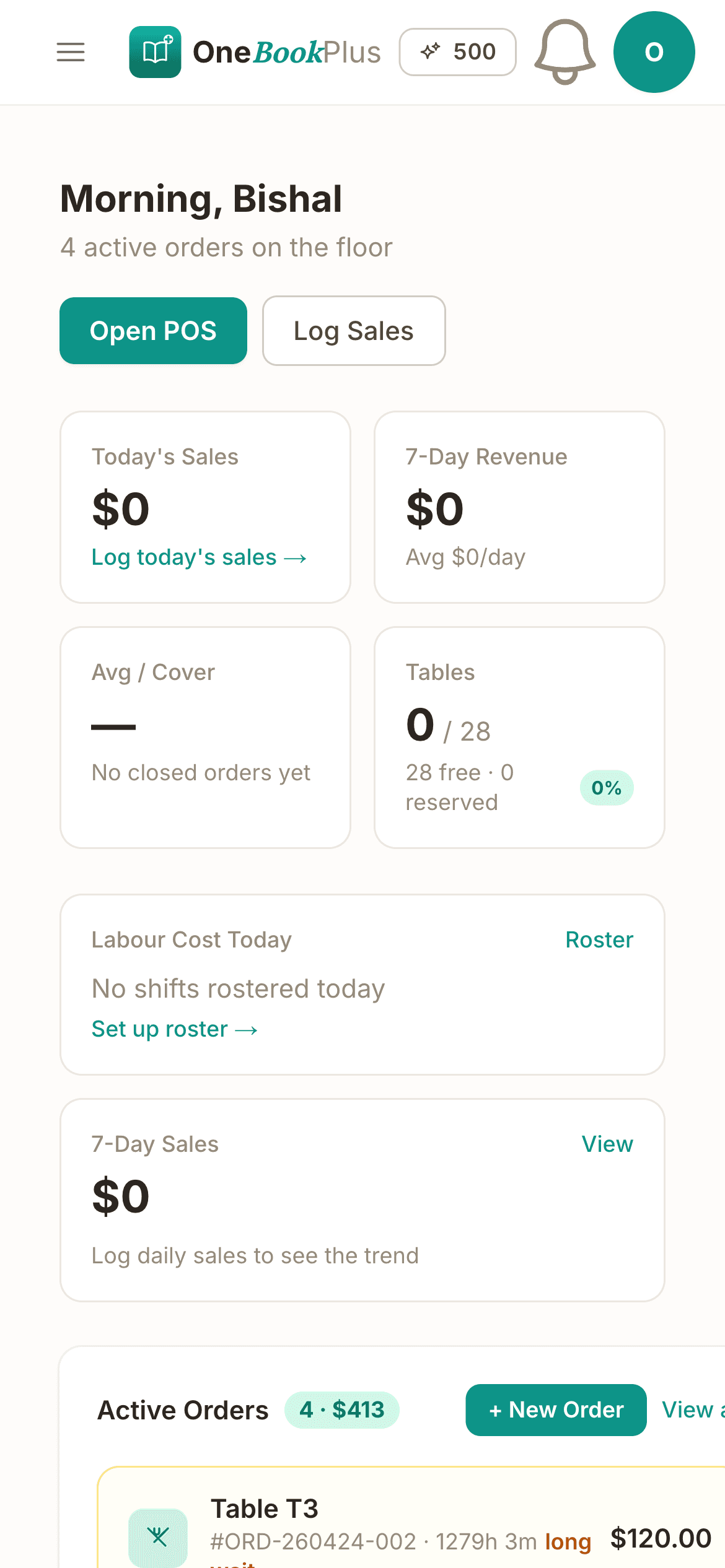
Type the first letters of a candle, scan a barcode with the phone camera or a counter scanner, then take cash or card. GST splits automatically, the SKU decrements, and the receipt goes out by email or SMS or prints to the printer the device already uses. The same till runs on the shop iPad and on the phone in your apron at a Rose Street or Salamanca market stall.
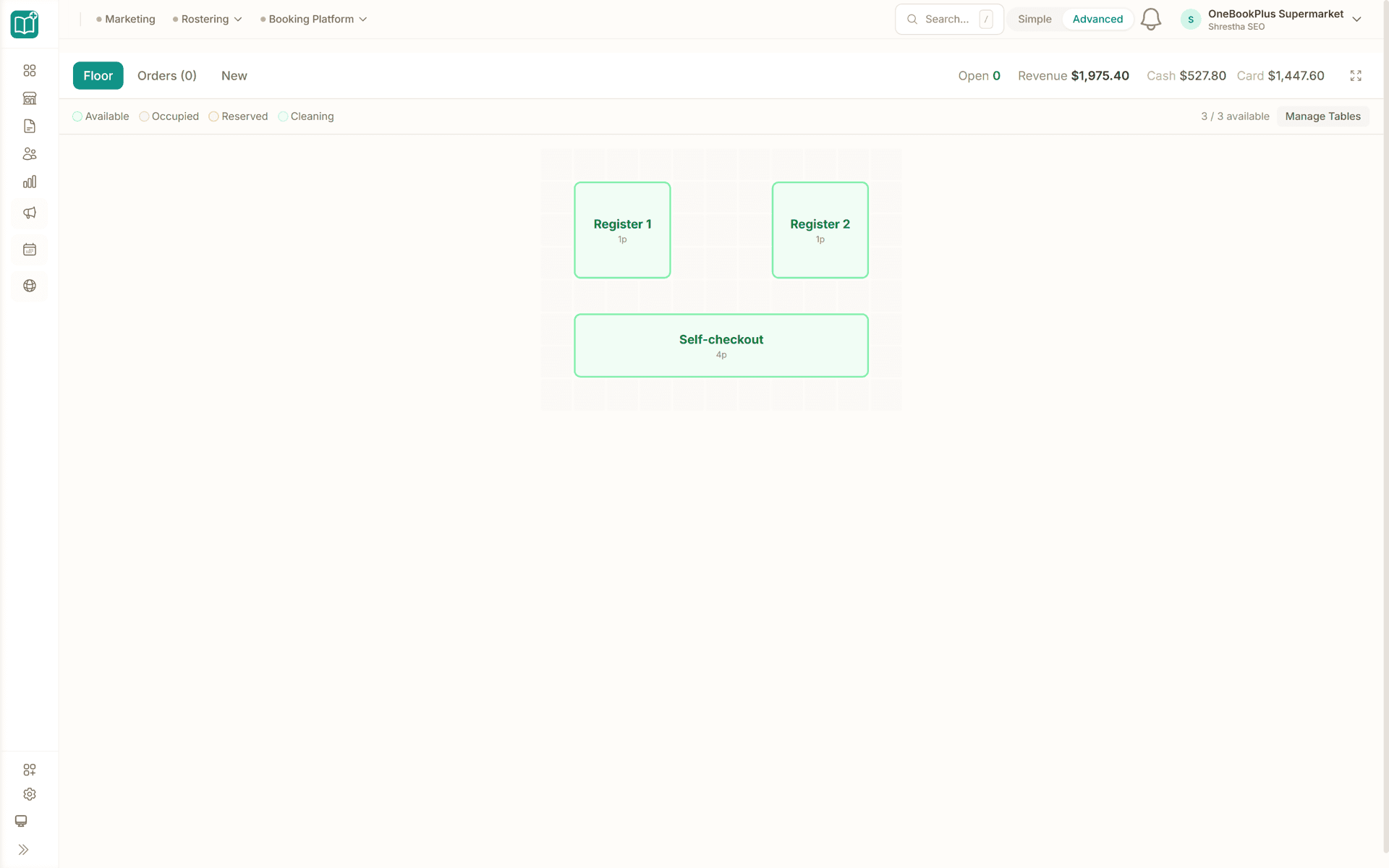
Stock on hand, low-stock and dead-stock at a glance
Every variant, size, colour, scent, carries its supplier cost, retail price and stock on hand. Low-stock alerts flag the best-seller trending to zero; dead-stock surfaces the variants that haven't moved in 30 days so you can mark them down before next season's order.
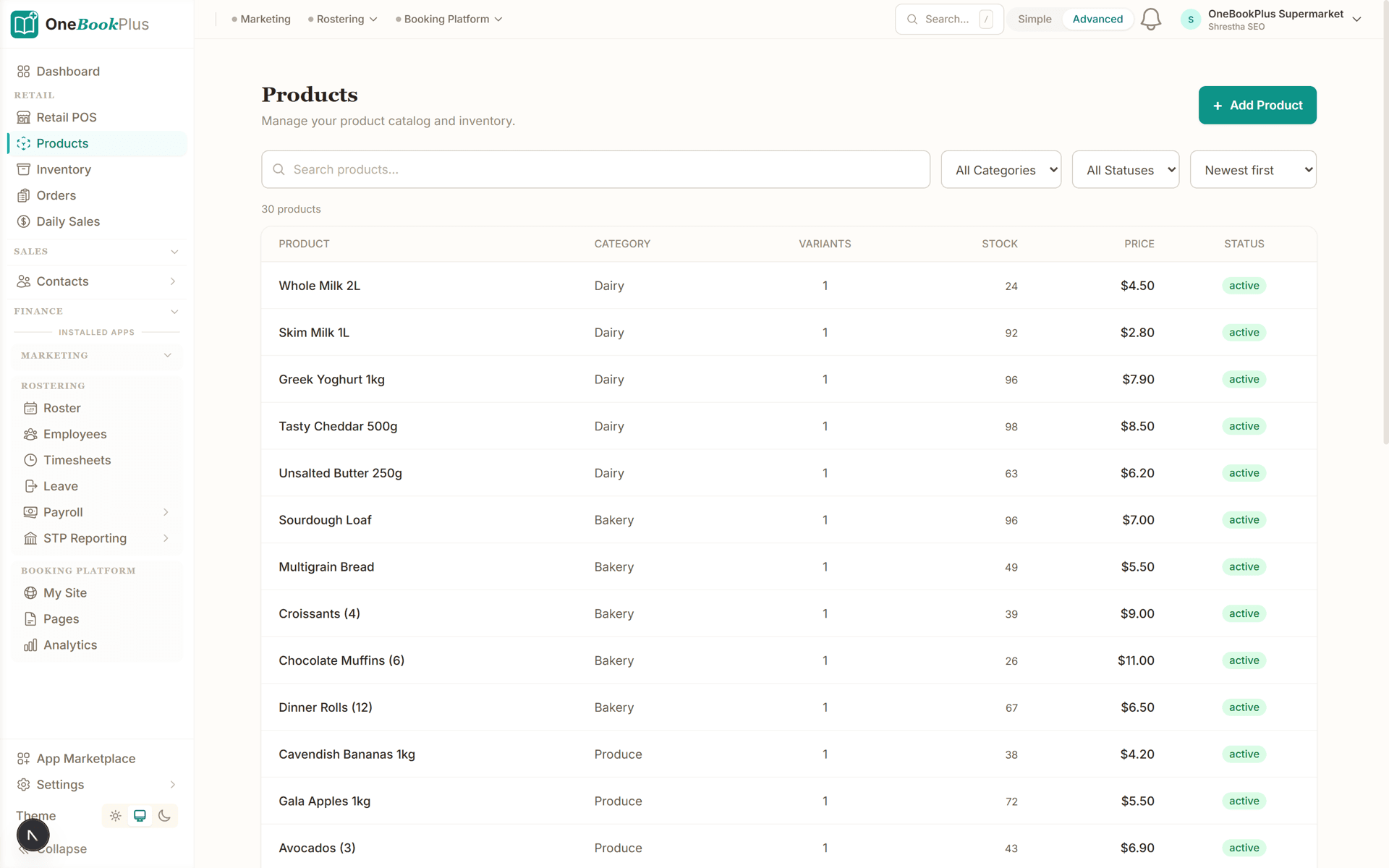
Daily takings, peak-hour reports and the quarterly BAS
Sales-by-hour and sales-by-weekday tell you when to roster the casual; the daily-takings ticker shows you're tracking ahead of the same Saturday last year. Raise a PO to your wholesaler, mark it received, and the supplier bill lands in expenses with 10% GST split, ready for the one-click BAS export.
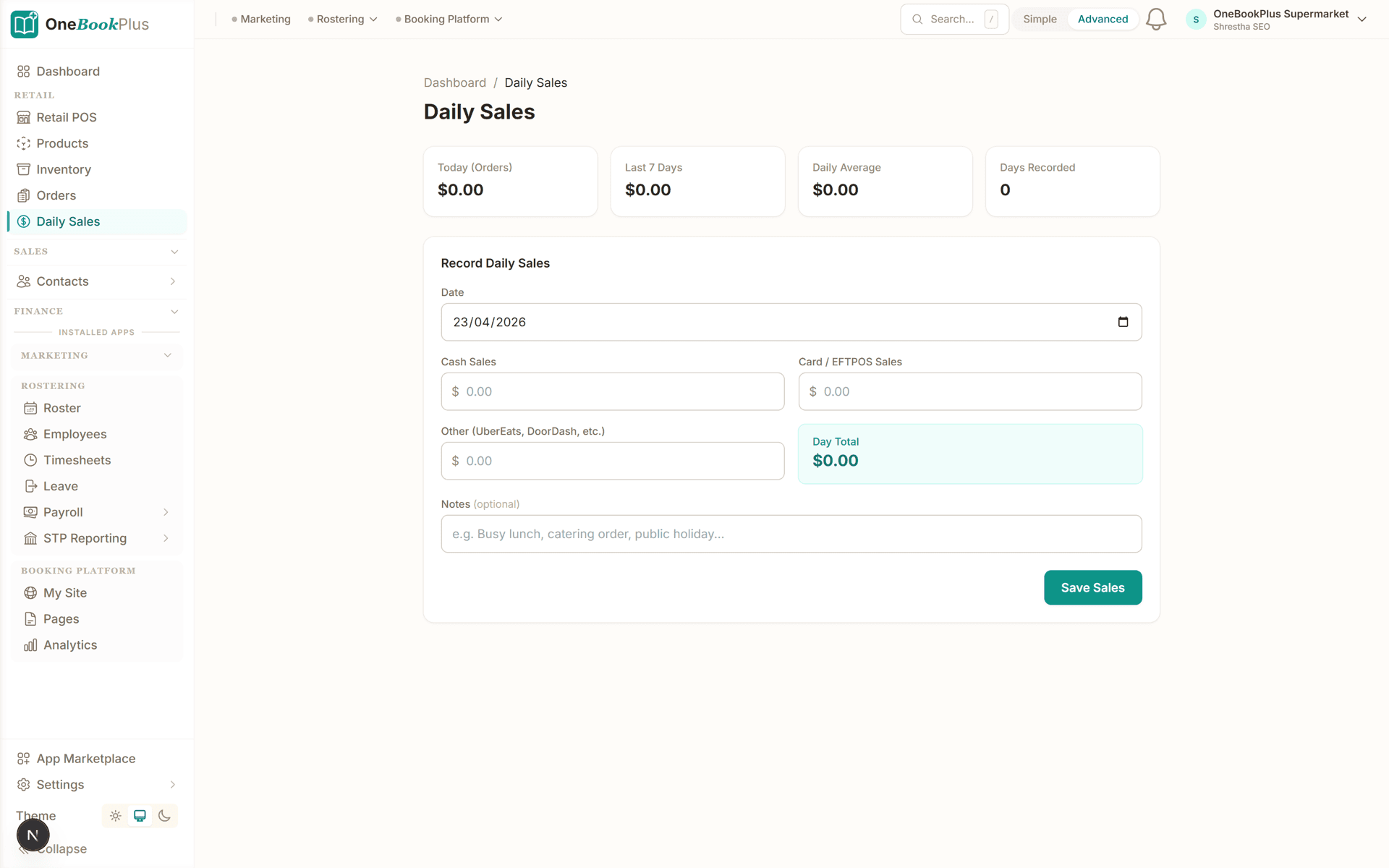
Simple Workflow
How OneBookPlus Works for Retailers
From shelf to receipt to BAS: four simple steps that match how an Australian retail business actually runs week to week.
Set up products & prices
Upload your SKUs (or import from a spreadsheet), set GST-inclusive prices, and load product photos. Variants like size and colour are handled out of the box.
Sell across channels
Ring up in-store on the counter, take a market-stall sale on the phone, or fulfil an online order. Stock decrements once, in one place: no double-handling.
Track stock & suppliers
Low-stock alerts surface on the dashboard. Raise purchase orders, mark them received, and the supplier bill drops into expenses with GST split automatically.
Get BAS-ready
GST collected and paid is tallied as you trade. Export the quarterly BAS summary, the P&L, and the stock-on-hand report in one click for your accountant.
Run a sale through the till the day you sign up
Built for Australian Retailers
$0
Free plan, no monthly fees, perfect for market stalls
1 app
Replaces POS + accounting + CRM + inventory
10%
GST handled automatically on every sale and bill
BAS-ready
Quarterly summary export in a single click
Who it's for
Built for every shape of retail
From a single-stallholder at Rose Street Artists' Market to a three-store homewares group, OneBookPlus shapes itself to how you trade.
Solo Boutique Owner
One shop, one owner, a casual on Saturdays. Needs fast counter POS, lightweight SKU tracking, an email list of regulars and 10% GST handled automatically. Free or Starter covers it.
Market Stall & Pop-Up Trader
Weekend Salamanca, Bondi or Queen Vic Market stalls. Needs a phone-only till, the terminal already in the van, two-tap cash sales and daily takings reconciled to the float.
Online + Bricks & Mortar
A high-street shop with a Shopify or Squarespace site. Needs one stock count across both channels so an online order never oversells what sold in-store ten minutes ago.
Multi-Location Retailer
Two to five stores, central buying, transfers between shops. Needs per-location stock, role-based access so each manager sees their own till, and consolidated BAS at head office.
What a four-tool stack costs each month
Named tools, at each vendor’s own cheapest published plan, and ours underneath. Vendor pricing changes, so check each one before you decide.
Or use OneBookPlus
$29/mo
Everything in the list above, on one bill.
Start freeNo credit card · Free forever · Cancel anytime
Example walkthrough
Saturday trade, counter to cash-up
An illustrative walkthrough of a typical trading day in a shop
Before you open, the dashboard shows yesterday's takings, the SKUs that have dropped below their reorder point, a layby balance falling due, and a supplier bill due next week. You confirm the layby with a tap.
Doors open. The first sale is a regular: the till recognises the phone number, applies the loyalty discount that customer has earned, and sends the receipt by SMS. By late morning the takings ticker is running against the same trading day last year, so you can see how you are pacing without adding anything up.
A pallet of new stock lands. You mark the purchase order received, the new SKUs are live on the till within minutes, and the supplier bill drops into expenses with the GST already split out.
In the afternoon a staff member takes the counter while you run a pop-up table out the front, the same system on your phone, taking the card on the terminal you carry out with you and logging cash in two taps. Stock decrements from one shared count, so the pop-up never oversells what is on the shelf inside.
A customer returns a faulty item. The refund, the restock and the GST adjustment happen in one record, so the evidence trail is intact if a consumer-law complaint ever follows.
End of day: the sales count and takings are already tallied, the cash reconciles to the float in a couple of minutes, and the GST for the day is recorded. Come BAS time, market days and shop days roll into one quarterly export.
How we compare
OneBookPlus vs retail POS software
How we compare to the tools Australian retailers actually run.
| Feature | OneBookPlus | Square POS | Lightspeed Retail | Shopify POS |
|---|---|---|---|---|
| POS terminal + mobile till | Yes | Yes | Yes | Yes |
| Inventory & SKU/variant tracking | Yes | No | Yes | Yes |
| Accounting & BAS reporting | Yes | No | No | No |
| Supplier bills & purchase orders | Yes | No | Yes | No |
| Customer CRM & loyalty | Yes | No | No | Yes |
| Layby | Yes | No | Yes | No |
| Market-stall / casual-trader friendly | Yes | Yes | No | No |
| ACL refund & return tracking | Yes | No | Yes | No |
| GST 10% & ABN built-in | Yes | Yes | Yes | No |
| Free plan available | Yes | Yes | No | No |
| Price | From $0/mo | Free (POS only) | Subscription | Priced in US dollars |
Built-in AI
Can’t get to the phone? Your AI can.
You're serving the counter, the phone rings for stock, orders and hours you can't get to.
OneBookPlus
AI Receptionist · incoming call
“Do you have the blue one in stock to pick up?”
If you don't answer, the AI books it, Click & collect · ready today 3pm, and texts a confirmation.
Australian Owned
Built in Melbourne, AU
GST Compliant
ATO-ready from day one
Encrypted & Isolated
TLS in transit, AES-256 at rest, tenant isolation at the database layer, read the security page
Free Plan Available
No credit card needed
Frequently Asked Questions
Common questions about POS, inventory and accounting software for Australian retailers.
What is the best retail POS software for a small business in Australia?
For an independent Australian shop the best setup usually combines POS, inventory, customer CRM and accounting in one place rather than running a card terminal plus a separate accounting tool plus a stock spreadsheet. OneBookPlus does that from $0/month, counter sales on a phone or tablet, SKU and variant inventory, supplier bills, layby, and BAS-ready GST reporting, with no per-transaction software fee beyond standard payment processing. It's a practical Xero or MYOB alternative for retailers who want their sales and accounts on the same data instead of exporting between two products.
Is OneBookPlus a full POS system for retail stores?
Yes. OneBookPlus runs as a tablet or phone POS at the counter and also handles inventory, supplier billing, customer CRM and BAS-ready reporting in the same product. Cards are taken on the EFTPOS terminal you already have, with the till recording the tender against the sale so it reconciles to your bank deposit, or through a Stripe Pay Now link on an invoice. Tap to Pay on iPhone is built but stays switched off in the public app until Apple grants the distribution entitlement. Where most retailers run Square POS plus Xero plus a spreadsheet for stock, OneBookPlus replaces the lot.
How is OneBookPlus different from Square, Lightspeed or Vend (Lightspeed Retail)?
Square is strong on the card terminal but light on inventory and accounting, and most Square users still bolt on Xero. Lightspeed Retail is feature-rich but charges a monthly subscription plus a transaction fee on top; read the current figure off their own page. Vend was rolled into Lightspeed Retail in 2021 and no longer sells under that name. OneBookPlus bundles POS, inventory, CRM, supplier bills, GST and BAS reporting from $0/month, with no per-transaction software fee beyond standard payment processing.
Does it work for market stalls and pop-ups, not just brick-and-mortar stores?
Absolutely, market stalls and pop-ups are a first-class workflow. You can run a casual-trader stall entirely from the phone, take cards on the terminal you already carry with the till recording the tender, log cash sales in two taps, and reconcile takings at the end of the day. Daily takings and GST are tracked the same as an in-store sale, so when BAS is due, market days and shop days roll into one report.
Can I track inventory across multiple SKUs, variants and locations?
Yes. Each product can carry variants (size, colour, flavour), supplier cost, retail price, and stock on hand. Low-stock alerts flag the SKUs trending toward zero before you actually sell out. If you trade from a shop plus a weekend market, stock can be tracked per location with transfers between them, so you don't oversell what's actually in the van.
Does it handle ACL consumer guarantees, refunds and returns?
The Australian Consumer Law (ACL) requires retailers to offer refunds, replacements or repairs for major faults, and acceptable-quality, fit-for-purpose goods regardless of any 'no refunds' sign. OneBookPlus tracks the original sale, the refund, the restock, and the GST adjustment in one record so your evidence trail is intact if a dispute lands in NSW Fair Trading or VCAT. Our Consumer Guarantees (ACL) reference page covers section 54, section 55 and the refund vs replace decision tree.
Can I run laybys and loyalty discounts?
Yes. Layby is a first-class workflow, take the deposit, the system holds the stock against the customer, and the balance can be paid in instalments via the customer's link or in-store. Loyalty is a simple percentage or dollar discount tied to a customer tag, applied automatically when the customer is recognised at checkout. Gift cards and store credit are coming soon as a marketplace add-on.
How does OneBookPlus handle multi-channel, shop, online and market stall in the same business?
Stock is the single source of truth across all three channels. A sale at the shop till decrements the same SKU that's listed on your online store and the same SKU sitting in the market-stall tub. Channels can be tagged per sale so you can see at a glance what proportion of revenue comes from each, typical mature retailers run 60-70% in-store, 20-30% online, 5-15% market days. The dashboard breaks it out so you can make decisions about where to put your time.
What about hardware, do I need a receipt printer, cash drawer or barcode scanner?
Not necessarily, and it is worth knowing what a browser can and cannot drive. Barcode scanners work today: any USB or Bluetooth scanner that types like a keyboard (Socket Mobile, Honeywell Voyager and most cheap ones) is picked up by the till with no setup, and the phone camera reads EAN-13, UPC, Code 128, Code 39 and QR with no hardware at all. Receipts print through the standard browser print dialog to any printer the device is already set up for, including an 80mm thermal printer with its driver installed on a desktop Chromium browser. A cash drawer opens the way it does on every browser POS, from the receipt printer it is plugged into, through that printer's driver, rather than from OneBookPlus. What OneBookPlus does not do is pair with a printer or a drawer directly: browsers cannot reach the Bluetooth profile that Star and Epson counter printers use. Many retailers skip the paper altogether and email or SMS the receipt from the till instead, which is built in and counts as proof of transaction.
About the author

Bishal Shrestha
Founder & CEO, OneBookPlus
Bishal spent a decade running digital projects for Australian small businesses before founding OneBookPlus. He writes and maintains these pages, and publishes what OneBookPlus does not do alongside what it does.
Read the founder bioHow this page was researched
The compliance and licensing statements above are taken from the bodies this page links to, including the ABS, the Reserve Bank and Consumer Affairs Victoria, so you can read the rule rather than take our word for it. Plan prices come from the OneBookPlus price registry, so the page and the checkout cannot disagree. Everything said about OneBookPlus describes what the product does today, and the page says so where it does not do something.
How OneBookPlus Works for Retailers
If you run a boutique shop on a high street, a homewares store in a regional town, or a weekend market stall under a gazebo, you already know the stack: Square or Lightspeed for the till, Xero for the books, a spreadsheet for stock, and probably a notebook for the supplier orders. Each tool costs money, none of them talk to each other properly, and at the end of the quarter you still hand the accountant a USB stick of CSV exports and pray they line up. OneBookPlus replaces all of that with a single app built for how Australian retailers actually work: on the counter, on the floor, at the market, and on your phone in the car between deliveries.
The platform covers the full retail lifecycle from supplier purchase order to customer sale to BAS lodgement. A supplier sends an invoice for a delivery of stock and you raise the purchase order in OneBookPlus. The goods land, you mark the PO received, and the stock-on-hand for each SKU is updated automatically. The supplier bill drops into expenses with the 10% GST already split. A customer walks in, you ring up the sale on the counter tablet (or the phone in your apron pocket if you're at a pop-up). The card terminal or Apple Pay handles the payment, the SKU decrements, and a receipt is emailed to the customer if they want one. Their email goes onto the CRM record so next time there's a new drop, you can message them directly without paying Mailchimp.
Your Daily Workflow
Picture a typical Saturday. You open OneBookPlus at 7:30am over a coffee. The dashboard shows yesterday's takings, two SKUs flagged as low stock, one customer awaiting a layby follow-up, and a supplier bill due Monday. You confirm the layby with a tap. The shop opens at 9am and the first sale is a regular: the system recognises her phone number, applies the 10% loyalty discount, and emails her receipt. By lunchtime, eight sales are through the till and the dashboard's daily-takings ticker shows you're tracking 12% above the same Saturday last month. At 1pm a pallet of new stock lands from your supplier. You scan the bar codes (or import the CSV the supplier sent), mark the PO received, and the new SKUs are live on the till by 1:15pm. At 6pm you cash out: takings reconcile to the float, the GST tally for the day is sitting at $187, and end-of-day takes about 90 seconds.
Market Stalls & Pop-Ups
For weekend market traders and pop-up operators, OneBookPlus runs as a fully mobile POS. No counter and no fixed till, just the phone in your apron pocket. Take the card on the terminal you already carry, with the till recording the tender against the sale. Tapping the card on the phone itself is not live: Tap to Pay on iPhone is built but stays switched off in the public app until Apple grants the distribution entitlement. Customers tap, pay, you hand them the goods, and the receipt goes to their phone by email or SMS if they want one. Cash sales go through in two taps; the takings sit alongside the card sales in the same dashboard. At the end of the market day, you reconcile cash to the float and the GST is already tallied. If you trade both a shop and a weekend market, stock is tracked per location so the stall doesn't oversell what's already gone from the shop floor. Casual-trader permits, public-liability insurance and stallholder paperwork are referenced in our Market Stall Permits by State guide so you know what your council requires before you turn up.
Accounting & BAS
Supplier bills go in by photo or PDF and the scanner reads the supplier, date, GST and total off them, so you are not typing a stack of invoices at the end of the week. Payments you record are matched to the bill or invoice they belong to, so accounts payable and the overdue list both stay clean. GST collected on sales and GST paid on bills are both tallied as you trade. When BAS time rolls around, quarterly for most retailers, you export a clean summary covering GST, sales, expenses and net amount due, and hand it to your accountant or lodge it yourself through the ATO portal. No shoebox of receipts, no Sunday-night spreadsheet reconciliation.
Consumer Guarantees, Returns & Refunds
Australian retail is governed by the Australian Consumer Law (ACL), which makes consumer guarantees automatic on every sale. If a product has a major fault, the customer chooses the remedy (refund, replacement or repair) and a “no refunds” sign is unlawful in that context. OneBookPlus tracks the original sale, the refund, the restock and the GST adjustment in one record, so if a dispute lands in NSW Fair Trading, Consumer Affairs Victoria or VCAT, your evidence trail is intact. Our Consumer Guarantees (ACL) reference page walks through section 54 (acceptable quality), section 55 (fitness for purpose) and the refund-vs-replace decision tree.
Getting Started
Sign up in under a minute. No credit card required. Add your ABN, upload your logo, set your default GST treatment and your payment terms. Import existing products from a Square, Shopify or Lightspeed CSV export, or add SKUs as you go. Most retailers are running their first sale through the till within fifteen minutes of signing up. The free plan covers unlimited sales and up to a few hundred SKUs, so you can trial the platform on a real Saturday before you commit. When you're ready for multi-location stock, advanced CRM segmentation or a larger team, upgrade to a paid plan, still a fraction of what a Lightspeed Retail plus Xero plus Mailchimp stack costs each month.
Industry Context
The Australian retail landscape in 2026
Australian retail turns over roughly $430 billion a year according to ABS Retail Trade data, with around 150,000 small-business retail operators (under 20 staff) making up the long tail. The discretionary categories (clothing & footwear, homewares, books, gifts, beauty) trade on 30-40% gross margins where every percentage point of stockholding cost matters. Food and grocery sit at 15-25% margins with much higher inventory velocity. In both cases, the operators who stay in business are the ones who understand stock turn, not the ones who chase headline sales.
Three forces have reshaped the sector in the last five years: (1) the post-COVID normalisation of online channels means even the smallest boutique now expects a click-and-collect or local-delivery option; (2) the rise of weekend markets, pop-ups and Sunday-trading laneways has created a new tier of casual-trader retail that doesn't fit the legacy POS systems built for fixed stores; and (3) payment behaviour has shifted decisively to tap-and-go. According to RBA Payments data, cash now accounts for under 10% of in-person retail transactions, down from over 30% pre-2020. Software built for the era of cash drawers and Friday-night banking is a poor fit for how retail is actually trading.
The compliance backdrop matters too. The Australian Consumer Law (ACL) sits over every retail sale. Consumer guarantees are automatic, “no refunds” signs are unlawful where a major fault exists, and disputes that aren't resolved in-store land at NSW Fair Trading, Consumer Affairs Victoria or VCAT. GST at 10% applies to most goods (with notable exceptions for basic food, education, health and some financial services), reported quarterly via BAS for most retailers. And for stallholders, the casual-trader permit landscape varies by council and state, with food handling adding an extra layer of state-health-authority requirements. OneBookPlus is designed against this entire compliance surface, not retro-fitted from a US or UK retail product.
One day, written by itself, an illustrated day of an Australian homewares shop run on OneBookPlus
An illustrated day, not real customer data. Scroll through it from morning to 5pm: the AI receptionist answers and books a missed call, the work runs from the app, the GST invoice is sent on the spot, payment lands and the books balance themselves, a review invite is queued for the next daily run, and the day closes with the ledger already written.
9:30am
While you're at the counter
The six-throws call you'd have missed.
An interior stylist needs six linen throws for a Friday shoot. She calls the first homewares shop on Google, yours. You're mid-sale.
AI Receptionist
Answered. Reserved. Texted.
The AI answers in two rings, checks live stock, reserves six throws for pickup and texts her a confirmation.
Between customers
The order picks itself.
The order card lists the SKUs, sizes and shelf spots. You pick and wrap between counter sales, stock decrements as you go.
From the counter
Invoiced from the counter, stock decremented.
One tap turns the reserved order into a GST invoice with a pay link. No till-roll arithmetic tonight.
While you're serving
Paid. Picked. Balanced.
The $748 order is paid by card at pickup, the books update themselves and $68.00 GST is set aside for BAS.
Reputation on autopilot
The review ask, once the shoot is done.
Two hours after pickup the AI asks the stylist for a review, timed to the delay you set. No chasing, no awkward ask.
The till closes itself
Takings reconciled to the float.
Takings reconciled to the float in seconds. The book did the rest.
$0
collected
0
admin tasks done by AI
0
evenings lost
An illustrated day, not real customer data. AI Receptionist is a $79/mo add-on that needs AI Companion ($25/mo, included on Growth), and AI Companion is what sends the review invite as well. The rest of the day is the app itself.
Retail pricing
Four plans. All built for retailers.
Free for solo market traders and brand-new boutiques. Paid plans only kick in when you're ready for multi-location stock, supplier bills, or a bigger team. No contracts, no per-till tax. Cancel any time.
Free
$0/forever
Ring up your first market-day sale today, no credit card.
- Unlimited sales & receipts
- Up to a few hundred SKUs + variants
- GST & ABN on every sale
- BAS-ready quarterly summary export
- Mobile POS, receipts by email or SMS
- Branded booking / click-and-collect page
Starter
$29/mo
Replaces Square POS + Xero + Mailchimp + your stock spreadsheet.
- Everything in Free
- Supplier bills, purchase orders & receipt scanning
- Customer CRM, loyalty & layby
- Email & SMS receipts
- Low-stock & dead-stock alerts
- Accounting, P&L & BAS reports
- 3 team members
No card · Drops to Free if you don't upgrade
Plus
$49/mo
Outgrowing the basics, unlimited contacts & bookings, advanced reporting.
- Everything in Starter
- Unlimited contacts & bookings
- Advanced reporting & analytics
- Batch invoicing
- Budget tracking
- 5 team logins
- 10 GB website media storage
Growth
$69/mo
For multi-store retailers running shop, online and market days side by side.
- Everything in Plus
- Multi-location stock & transfers
- Per-channel reporting (shop / online / market)
- Role-based team access per store
- Peak-hour & sales-by-weekday reports
- Reputation Engine (auto Google reviews)
- 10 team members
Prices in AUD inc. GST. Payment fees sit on top: Square 1.6% or Stripe 1.7% + 30¢ on AU cards, and online card payments taken through OneBookPlus also carry a 2.5% platform fee. See the full plan comparison
Already on another POS?
Switching from Square, Lightspeed Retail or Shopify POS?
Switching is designed to fit in a single evening after close. Export your products and customers as CSV from your current POS, import them into OneBookPlus with the bulk importer, and you're ringing up sales before the shutter goes up tomorrow.
- 1Export your product + customer CSV from Square, Lightspeed or Shopify (5 min)
- 2Upload via the bulk importer, SKUs, variants, prices and stock auto-map (10 min)
- 3Set your GST treatment, ABN and suppliers, then point the till at how you take cards (15 min)
- 4Cancel your old POS and Xero subscriptions tomorrow, coffee in hand
Switch from
Who It's For
Built for every shape of Australian retail
From the single-stallholder weekend trader to the multi-location homewares group, OneBookPlus shapes itself to how your retail business actually runs.
Solo Boutique Owner
One shop, one owner-operator, maybe a casual on Saturdays. Needs fast POS, lightweight stock tracking, an email list of regulars, and GST handled automatically. Free or Starter plan covers it.
Multi-Location Retailer
Two to five shops, central buying, transfer stock between stores. Needs per-location stock counts, role-based access so each shop manager sees their own dashboard, and consolidated BAS reporting at head office.
Online + Bricks & Mortar
A high-street shop with a Shopify or Squarespace site. Needs one stock count across both channels, so an online sale doesn't oversell what was already sold in-store ten minutes earlier.
Market Stall & Pop-Up Trader
Weekend markets, festival stalls, or seasonal pop-ups. Needs a fully mobile POS, casual-trader-friendly card terminal, daily takings reconciliation, and the option to step up to a permanent shop when ready.
Compared To
OneBookPlus vs Square, Lightspeed & Shopify POS
The three platforms most Australian retailers actually compare. Headline pricing as of early 2026. Transaction fees, hardware and add-ons sit on top in every case.
| Feature | OneBookPlus | Square POS | Lightspeed Retail | Shopify POS |
|---|---|---|---|---|
| Software cost from | $0/mo | Free | Subscription | Priced in US dollars |
| POS terminal & mobile till | Yes | Yes | Yes | Yes |
| Inventory & SKU tracking | Yes | Limited (free) / paid add-on | Yes | Yes |
| Accounting & BAS reporting | Yes | No (needs Xero) | No (needs Xero) | No (needs Xero) |
| Customer CRM & loyalty | Yes | Paid add-on | Paid add-on | Yes (Shopify side) |
| Supplier bills & purchase orders | Yes | No | Yes | Limited |
| Market-stall / casual-trader friendly | Yes | Yes | Heavy for stalls | Heavy for stalls |
| GST 10% & ABN built-in | Yes | Yes | Yes | Configurable |
| ACL refund & return tracking | Yes | Manual | Yes | Manual |
| Free plan available | Yes | Yes (POS only) | No (free trial only) | No |
Pricing accurate as of May 2026 from the vendor websites; payment-processing fees (Square 1.6%, Lightspeed payments, Shopify Payments) and hardware sit on top.
Stop Juggling POS, Xero and a Stock Spreadsheet.
Join Australian retailers and market traders running their whole business from one app. Free to start. Upgrade when you're ready.
Get started freeReviewed by Bishal Shrestha
Authoritative sources
Where the regulatory, tax and consumer-law facts on this page come from
Australian retailers trade under the Australian Consumer Law, the GST and BAS regime, the General Retail Industry Award, and council/state casual-trader rules. We cite the primary bodies for the claims on this page so you can verify directly.
- ACCC, Consumer rights & guarantees (Australian Consumer Law) , Section 54 acceptable quality, section 55 fit for purpose, and why “no refunds” signs are unlawful for major faults.
- ATO, GST registration & the $75,000 turnover threshold , When a retail business or market stall must register for GST and report quarterly via BAS.
- General Retail Industry Award 2020 (MA000004) , Modern award covering pay rates, penalty rates and conditions for shop and counter staff.
- ABS, Retail Trade, Australia , The ~$430bn annual turnover and category-level data referenced on this page.
- RBA, Consumer Payments Survey (cash vs tap-and-go) , The shift to contactless payments and the decline of cash in in-person retail.
- Consumer Affairs Victoria, Refunds & returns , State consumer regulator that handles unresolved retail refund and return disputes (alongside NSW Fair Trading and VCAT).
From the blog
Related reading for retail
Practical guides and explainers from the OneBookPlus blog, grouped by topic.
Australia's Payroll Tax Cliff
Pay $1.5 million in wages and you owe $31,731 in payroll tax in Western Australia and nothing in South Australia, the NT or the ACT. Every threshold, rate and trap across all eight Australian jurisdictions for 2026-27.
13 min readRead articleThe Card Surcharge Ban 2026: What It Really Costs (and Saves) Australian Small Business
From 1 October 2026 you cannot surcharge eftpos, Mastercard or Visa. What the RBA reform costs and saves you, modelled by business type.
14 min readRead articlePayday Super 2026: The Employer's Guide to Paying Super Every Payday
From 1 July 2026 employers must pay super every payday and have it in the fund within 7 business days. A plain-English guide to the rules, SGC and cash flow.
16 min readRead articleThe Australian Small Business Cash Flow & Late Payments Report 2026
In the March quarter 2026, Australian small businesses waited an average of 24.1 days to be paid and were paid 6.9 days late (Xero Small Business Insights). This fully-sourced report aggregates the latest getting-paid, cash-flow, insolvency and payments-reform figures from Xero, the Payment Times Reporting Regulator, the RBA, ASBFEO, the ABS, CommBank-UNSW and CreditorWatch into one extractable resource.
27 min readRead article
Extend Your Toolkit
Recommended Apps
Industries
Features
Comparisons
Local directory